Devpost
Participate in our public hackathons
Devpost for Teams
Access your company's private hackathons
Grow your developer ecosystem and promote your platform
Drive innovation, collaboration, and retention within your organization
By use case
Blog
Insights into hackathon planning and participation
Customer stories
Inspiration from peers and other industry leaders
Planning guides
Best practices for planning online and in-person hackathons
Webinars & events
Upcoming events and on-demand recordings
Help desk
Common questions and support documentation
Lightweight middleware for secure multi-agent workflows, adding capability-based routing, scoped data access, human approvals, policy enforcement, and exactly-once execution to Agent Launchpad.
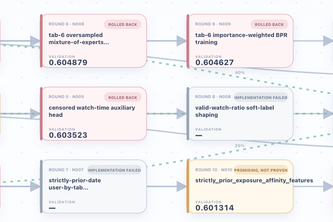
Find better models. Build an even better ensemble.
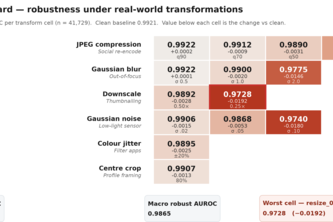
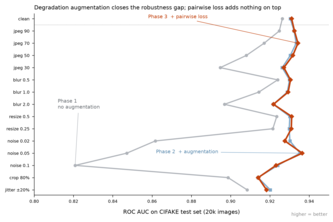
Most AI-image detectors ace clean benchmarks and collapse on real uploads. Ours holds 0.99 AUROC across every compression, blur, crop and noise level tested, and 0.95 on a generator it has never seen.
A detector that stress-tests its own answers, so you know which ones to trust.
An autonomous ML research agent for recommender systems: forms its own hypotheses, writes the code, reads the metrics, and decides what to try next.
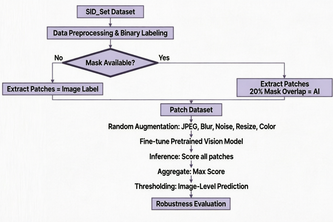
We detect AI-generated images through our pipeline that utilizes DINOv2, overlapping patches, and real-world augmentations to capture subtle local AI artifacts and improve robustness.
CrossGuard: Robust AI-image detection system that scores images for AI generation, is reliable under various compression techniques, and routes uncertain cases to review instead of forcing takedowns.
We stopped optimizing how the agent ranks and started optimizing when it knows enough to rank. 2.75 turns to converge, 0 LLM tokens, $0 per session, and +60 rank-1 hits on 800 unseen sessions.
An LLM-driven agent that runs the ML research loop without a human in it: propose a hypothesis, write a complete training script, execute it in a sandbox, score it, reflect on the result, repeat.
Same outputs, 7.1x faster: hand-tuned Triton kernels and CUDA graphs for Transformers on a Tesla T4.
Ele is a robust AI-generated image detector built to spot synthetic media even after it has been degraded by real-world manipulations like JPEG compression, blur, resizing, and noise.
The harness measures; the agent decides.
A multiagent that can coordinate and reuse what it learns.
A conversational shopping agent over a frozen 50k-item Amazon catalog: hybrid BM25/dense/metadata retrieval, cross-encoder rerank, a calibrated dialog state machine, optional LLM rerank, 10-turn cap.
This is an AI image detection software pilot project.
Mercury helps you find the correct product through a conversation. It asks useful questions, remembers what matters and adapts when your preferences change without making you repeat everything again.
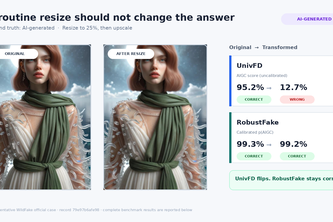
RobustFake detects AI-generated images—even after resizing, compression, cropping, blur, and reposting.
Conversational shopping copilot with a focus on accessibility-aware retrieval and ranking.
"Conversational search that tightens with every clue, and never asks a question it already knows the answer to."
A shopping copilot that asks the right questions to close the gap between buying and browsing.
An adaptive shopping copilot that understands evolving intent, combines lexical and semantic retrieval, and asks smarter questions to find the right products faster.
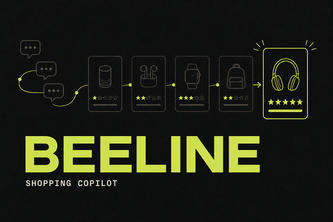
Beeline: turn buying intent into purchase before the next swipe.
tictac's middleware connects users, projects, Agents, and protected data, handling delegation, access control, workspaces, and run tracking so Codex Agents can collaborate safely.
Ten allowed, 2.2 used. Ten Turns treats this as recognition, not search: the shopper is quoting the target's own catalog row. HR@10 1.000, 54s, standard library only, bit-for-bit reproducible.
193 – 216 of 614